
Ideally, our teeth should line up as neatly as the keys of a piano. Unfortunately, many of us have to live with crooked teeth, crowded smiles, or poorly aligned bites.
Or do we?
Turns out, it’s never too late to get a perfect smile.
Childhood, when there is maximum bone growth is the best time to make changes in the positioning of the teeth. However, more and more adults are opting for orthodontic treatment too.
If you’ve been thinking about braces, here are some things to keep in mind.
How Adult Braces Work
Braces are among the most common orthodontic appliance. Brackets are cemented or bonded to the tooth surfaces and are regularly adjusted as each tooth migrates into the desired position.
Braces provide a constant pressure to gently push one or more teeth in the desired direction. As each tooth is subjected to side pressure, it causes the root to press against the bone that anchors it in place.
With time, this force causes the bone to dissolve, permitting the tooth to migrate in the desired direction. As it does, new bone builds up in the vacated space on the opposite side of the root.
Sometimes elastic bands or springs are attached to the wires to boost the directional push.
Types of Adult Bracing
When it comes to adult braces, there are many choices these days. Each has its pros and cons and is usually selected based on clinical objectives, cost and personal preferences:
Traditional braces – These days conventional braces hold metal wires to brackets cemented to the front of a tooth. Anchored by teeth in the back of the mouth, wires are slowly tightened every 4 to 6 weeks.
A newer innovation switches out the metal for clear or tooth-colored ceramic. Traditional braces often produce results more quickly than other choices, but aesthetically, the most noticeable.
Lingual braces – These are similar to traditional braces, except the brackets are cemented to the inside of each tooth. This makes the braces practically invisible. If aesthetics are a primary concern this might be a good choice.
The downside of lingual braces is that they often come with a higher cost, require more care than traditional braces and can irritate the tongue. Some report that it makes speech more difficult.
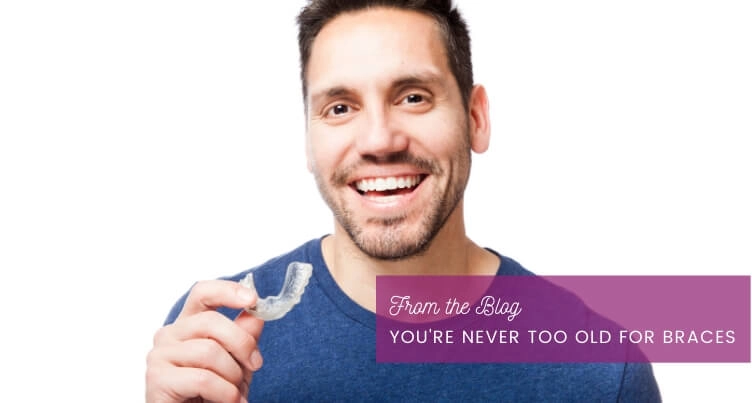
Clear aligners – A popular choice are plastic trays that are precisely moulded to fit your teeth. They remain in your mouth except when you’re eating or brushing your teeth. Periodically they are replaced with new ones that slowly coax teeth into a more desirable position.
The downside of clear aligners is that they’re not attached to your teeth so they can be misplaced or not immediately put back in place after meals or cleaning. They are probably the first choice when less dramatic teeth movement is required.
Are You a Good Candidate?
Braces may not be for everyone.
One deal breaker is poor gum health. If you have an active case of gum disease, that needs to be resolved before adding braces to the mix.
Sometimes adult patients may not have sufficient bone density between the roots or lack an adequate blood supply. Plus, there are bio-mechanical limitations as to what can be reasonably expected.
The only way to know for sure is a thorough examination. If you’re thinking about braces, ring us to arrange a time when we can explore the options and make recommendations.